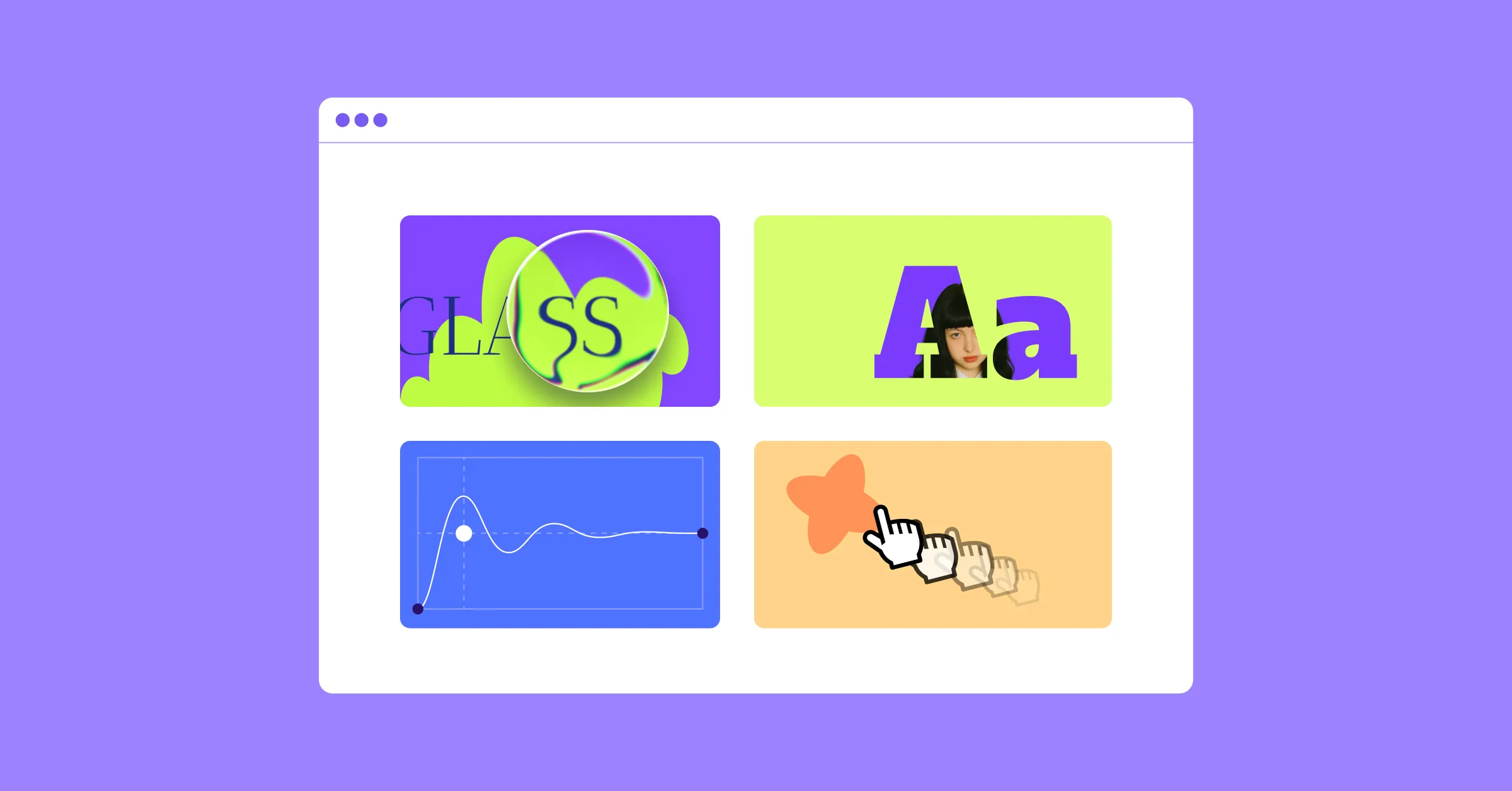
Ever see a website effect and think “I want that on my site!” but then realize you don’t know how to code it, or that your no-code tool simply can’t handle it?
Here’s the good news: you don’t need complex coding or extra plugins to create striking web design effects anymore. In this article, we’ll show you cool website effects in WordPress you can add without code and complex setups, effortlessly using Kirki.
So let’s dive right in!
Sleek and Modern Glass Effect
First up on our list is one of the most talked-about UI trends in modern web design, the Glass Effect, often referred to as Glassmorphism.
By mimicking the look of frosted or translucent glass, this effect adds depth and a premium, futuristic feel while keeping designs clean and minimal. It’s commonly used in cards, navigation menus, buttons, and more, as its versatility makes it easy to fit into almost any layout.
At first glance, you might assume pulling this off in WordPress would require tons of back-breaking CSS. Traditionally, that would be true. But with Kirki, it’s quite simple.
How to Create the Glass Effect in WordPress With Kirki
Step 1: Select the element you want to apply the glass effect to. Make sure it doesn’t have a background, or reduce its opacity as a stylistic choice.
Step 2: In the Design tab, scroll down to the Style section and click Add next to Glass to enable it.
Step 3: A Glass settings panel will open with controls for Refraction, Depth, Dispersion, Blur, and Light. Adjust these to fine-tune the frosted glass look to your preference.
And just like that, adding a sleek glass effect is that easy with Kirki!
Interactive Cursor Trail Animation
Next up is an effect that instantly makes your website feel more interactive and playful – the Cursor Trail Animation.
This effect causes an element to follow the user’s cursor as they move across the screen or within a specific section, creating a visual trail that adds personality and motion to your site. And with Kirki, you don’t need to write a single line of code to implement it.
How to Add an Interactive Cursor Trail Animation
Step 1: Select your element and open the Interaction tab on the right panel. Click Add trigger + and select Scroll into view.
Step 2: Under Scrolled Into, click “+” and from the response options select Library, then choose Cursor Trail.
Step 3: A settings panel will appear with the following options. Set the Container to either Parent (to keep the trail within the element’s parent container) or Viewport (to let it span the full screen). Then adjust Smoothing to control how fluid the cursor movement feels.
Just like that, you’ve added an interactive cursor trail animation that brings subtle motion and personality to your site with no code required!
Playful Spring-Based Transition
Spring-based Transitions are another effect that adds natural, playful motion to your WordPress website.
Instead of moving an element from point A to point B in a linear way, this effect mimics real-world physics to produce a spring-like motion that feels smooth and satisfying. These transitions work especially well for hover interactions, button clicks, modal reveals, and section animations. When used thoughtfully, they add personality and create a memorable user experience.
In Kirki, achieving a spring-based transition is as easy as a few clicks accessible from two places: the Transitions section in the Design tab, or the Timing Editor within any interaction.
How to Add Spring-Based Transitions in WordPress
Step 1: Select your trigger element and open the Interaction tab. Click Add trigger + and choose your desired trigger, in this example, Hover.
Step 2: Under Hover In, click “+” to add a response. Select Set New, then choose your target element and add any action, such as Move, Size, or Rotate, and set your desired values.
Step 3: At this stage, the animation will work but may feel a bit abrupt. To apply a spring transition, click on the action in the timeline to open its settings. Switch to the Timing Editor and select the Spring tab.
Step 4: In the Spring Timing Editor, you’ll find controls for Curve, Duration, Delay, and Bounce. Adjust these to get your desired spring effect. You can hover over the live preview at the bottom to see it in action before applying.
Step 5: To enhance the interaction further, add additional actions to your response — such as a Radius change on the card, and apply the same Spring transition to each for a cohesive, physics-based feel across the entire animation.
Step 6: Finally, duplicate your response for Hover Out and reverse all the values so the animation smoothly returns to its original state with the same satisfying spring effect.
Alternatively, you can also apply Spring transitions directly from the Transitions section in the Design tab, without setting up a full interaction — perfect for quick, passive transitions on hover states.
Advanced Text Effects: Shadows, Gradients, and Clip Masks
Text does more than just fill space on a website. It highlights key messages, communicates your brand value, and drives action.
But often, important messages blend into the surrounding design and fail to stand out. This is where advanced text effects can make a real difference. A subtle shadow can improve readability and add depth. Gradients can make important headings pop. And Clip Masks can create bold, high-impact visuals that instantly grab attention.
With Kirki, applying all of these effects is completely visual and straightforward, with no CSS tricks or complex code required.
How to Add Text Shadow
Step 1: Select your text element and, in the Design tab, scroll down to the Style section. Click Add next to Shadows and select Text Shadow.
Step 2: A Text Shadow panel will open. Adjust the Position (X and Y offset), Blur, and Color to get the preferred depth and contrast for your text shadow.
How to Create Gradient Text
Step 1: Select your text element and, in the Design tab, click Add next to Fill under the Style section to open the Fill panel.
Step 2: Select a gradient type — Linear, Radial, or Conic — and use the available controls to choose colors, position color stops, and adjust the angle or direction to fine-tune the look.
Step 3: Adding an image or gradient fill to a text element automatically clips it to the text shape — so your gradient will apply directly to the lettering instantly.
How to Add a Text Clip Mask Effect
Step 1: Select your text element and click Add next to Fill in the Style section to open the Fill panel.
Step 2: Select the Image icon (fifth icon) at the top of the Fill panel. Click Upload or Browse to choose your image.
Step 3: Just like with gradients, adding an image background to a text element in Kirki automatically clips it to the text — masking the image within the lettering with no extra steps needed.
With just a few clicks, you can turn plain text into a bold focal point that stops visitors in their tracks.
Do make use of these effects sparingly and strategically — you don’t want to create visual chaos, overwhelm the design, or reduce readability. A little goes a long way with advanced text effects.
And beyond these effects, you can also animate text effortlessly in Kirki using preset text animations like Text Stagger and more. Check out our full guide on How to Instantly Animate Text With No Code for a deeper dive!
Level Up Your WordPress Website With Kirki
From sleek glass effects to playful spring transitions and interactive cursor trails — these are just a few of the cool website effects in WordPress you can add without code, as long as you have the right tools.
With Kirki, implementing these effects and many more is quick, effortless, and requires no extra plugins or costs.
So go ahead, level up your WordPress website today and bring it to life with Kirki!

